People are often surprised to learn how few basic ingredients go into a wheel of good Italian cheese: milk, a culture of bacteria, rennet, and salt. That is essentially it. No additives, no preservatives, no long list of inputs. The complexity of flavour that develops over weeks and months of ageing emerges from the interaction of those four things — and from the skill and judgment of the people managing the process.
Understanding how cheese is made will change the way you eat it. Once you know what goes into the creation of a well-aged Pecorino or a fresh Burrata, the flavour takes on a different kind of meaning. You begin to taste the decisions.
Here is the full process, as we practise it at Latteria Santo Stefano.
Step 1: Milk Collection
Everything starts with milk, and the quality of the milk determines the potential of the cheese. We collect milk from seven farms within 20 kilometres of the dairy each morning. For our Pecorino, the milk comes from Sardinian and Massese sheep. For our Fior di Latte and Formaggio di Collina, we use milk from Holstein-Friesian and Chianina crossbreed cows kept on pasture wherever possible.
The milk arrives at the dairy within two hours of milking. This is important: the longer fresh milk sits before processing, the more the naturally occurring bacteria multiply and the more the milk's character changes. We begin cheesemaking within hours of collection, which is why the flavour of our fresh cheeses has a liveliness that refrigerated, transported milk cannot produce.
We do not homogenise our milk. Homogenisation — the process of forcing milk through a fine mesh to break up fat globules and prevent cream from separating — disrupts the natural structure of the milk and affects the texture and flavour of the resulting cheese. We do use gentle pasteurisation for our fresh cheeses to ensure safety, but our Pecorino Stagionato is made from raw milk, as tradition and regulations permit for aged cheeses.
Step 2: Warming and Adding the Starter Culture
The milk is poured into large copper or stainless steel vats and warmed gently to the temperature appropriate for the type of cheese being made. For our Pecorino, this is around 35–38°C — close to the body temperature of the sheep, which gives the bacteria conditions they recognise.
Once the milk reaches the right temperature, the starter culture is added. Starter cultures are communities of beneficial bacteria — primarily lactic acid bacteria — that consume lactose (milk sugar) and produce lactic acid. This acidification is essential: it begins to change the structure of the milk proteins, creates the conditions necessary for rennet to work effectively, and starts developing the flavour compounds that will define the finished cheese.
At Latteria Santo Stefano, we use a natural whey culture — bacteria-rich whey saved from the previous day's cheesemaking and kept alive between batches. This approach, called innesto naturale, maintains a community of bacteria that has adapted specifically to our dairy environment and our milk. The culture is, in a very literal sense, a living piece of our dairy's history. It is one of the main reasons our cheese tastes the way it does and could not be exactly replicated elsewhere.
Step 3: Adding Rennet and Coagulation
Once the starter culture has had time to acidify the milk slightly — typically 20 to 40 minutes — rennet is added. Rennet is an enzyme, traditionally derived from the stomach lining of young ruminants (lamb or kid rennet for sheep's and goat's milk cheeses; calf rennet for cow's milk cheeses), that causes the milk proteins to link together and form a gel.
The transformation is remarkable to watch: within 30 to 60 minutes of adding rennet, the liquid milk has become a firm, custard-like mass called the coagulum or gel. It holds its shape when cut with a knife and springs back slightly when pressed — signs that the coagulation is complete.
The type of rennet used affects flavour. Traditional animal rennets contribute their own enzymes to the flavour development of aged cheeses; this is one reason why long-aged Italian cheeses made with traditional rennet have a complexity and depth that cheeses made with microbial or vegetable rennet lack.
Step 4: Cutting the Curds
Once coagulation is complete, the cheesemaker cuts the gel into small pieces using a wire instrument called a lira or cheese harp. This cutting step is critical: the size of the curd pieces determines how much moisture the final cheese will contain, and therefore how soft or hard it will be.
For a fresh, high-moisture cheese like Ricotta or Stracchino, the curds are cut into large pieces — the size of a walnut or larger — to retain as much whey as possible. For a hard, aged cheese like Pecorino Stagionato or Parmigiano-Reggiano, the curds are cut into very small pieces — the size of a grain of rice — to encourage maximum whey expulsion.
At Latteria Santo Stefano, we cut the curds for our Pecorino to roughly the size of a hazelnut. After cutting, the curds are stirred gently in the whey while the temperature is raised gradually. This cooking step — called cottura — firms the curds further, expelling more whey. The stirring prevents the pieces from clumping together before they are ready.
Step 5: Draining and Moulding
When the curds have reached the right texture — firm but not hard, with a slightly squeaky quality — they are separated from the whey. The whey is not discarded: it will be used to make Ricotta by being heated again to precipitate the remaining proteins.
The curds are transferred into moulds — typically cylindrical forms that give the cheese its characteristic disc shape. For fresh cheeses, the moulds are lined with cheesecloth to allow whey to drain freely. For harder cheeses, the curds may be pressed with weights or mechanical presses to expel additional moisture.
At this stage, our Pecorino wheels weigh approximately 1.2 to 1.5 kilograms. They will lose a significant portion of this weight through the combined effect of pressing, salting, and ageing.
Step 6: Salting
After moulding, the cheese is salted. Salt plays several roles in cheesemaking: it draws moisture out of the cheese by osmosis, slowing the growth of unwanted bacteria and moulds; it influences the texture, making the rind firmer; and it is essential for flavour.
There are two main salting methods. The first is dry-salting, where salt is rubbed directly onto the surface of the cheese. The second is brine-salting, where the cheese is submerged in a saturated salt solution for a defined period. We use brine-salting for our Pecorino, immersing the fresh wheels in a cool brine bath for 12 to 24 hours depending on their size.
After salting, the young cheeses are dried briefly in the open air of the dairy before moving to the ageing room.
Step 7: Ageing and Maturation
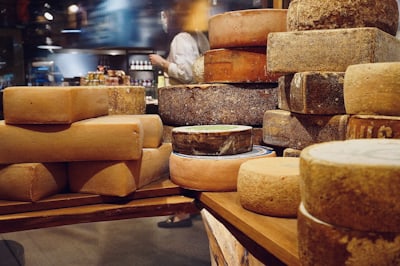
This is where patience becomes the primary ingredient. Our Pecorino Stagionato spends a minimum of 90 days in our stone-floored ageing room, where temperature is maintained at around 10–12°C and humidity is kept high. During this time, the cheese loses moisture slowly and steadily, concentrating its flavours and developing its rind.
The wheels are turned regularly — every few days in the early stages, less frequently as they firm up — to ensure even moisture loss and prevent one side from drying out faster than the other. They are also rubbed periodically with a mixture of olive oil and salt to protect the rind and regulate surface mould growth.
During ageing, the enzymes produced by the bacteria and the rennet continue to work, slowly breaking down the proteins and fats in the cheese into smaller molecules that produce flavour. This process — called proteolysis and lipolysis — is responsible for the complex, deep flavour of aged cheese. The longer the ageing, the more time these reactions have to develop, which is why a 24-month Pecorino stagionato tastes dramatically different from a 3-month version made from the same milk.
Step 8: Finishing and Release
At the end of the minimum ageing period, each wheel is assessed individually. A skilled cheesemaker evaluates the rind, the aroma, the colour, and — by tapping the wheel gently with a small hammer and listening to the resonance — the interior structure. Wheels that have developed unevenly or show signs of unwanted problems are set aside.
Those that pass the assessment are released for sale. Some are kept back for additional ageing, emerging months later as richer, more intensely flavoured versions of themselves.
From the morning milk delivery to a fully aged wheel on the counter, the process takes a minimum of four months. Every day of that period requires attention, judgment, and care. That investment of time and human skill is what distinguishes genuine artisan Italian cheese from industrial production — and it is why the flavour is worth every moment of the wait.
If you would like to see this process first-hand, we welcome visitors to our dairy in San Gimignano by appointment. Contact us to arrange a visit.
Continue Reading